
For a long time, I thought ergonomics was something you only worried about after something went wrong. A bad back. Chronic neck pain. A doctor’s warning.
That was my mistake.
At home, I looked fine. I wasn’t lifting heavy weights or doing anything extreme. I was just living, working at my desk, reading on the couch, cooking meals, scrolling on my phone. Yet by evening, my body felt oddly heavy. My shoulders burned. My lower back felt tight and compressed. Some days, I felt tired even though I hadn’t done anything that looked “hard.”
What I eventually realized is this: most fatigue is not caused by effort, but by poor alignment repeated for hours.
Ergonomics didn’t change my life overnight. It changed it quietly.
What Ergonomics Actually Means (In Real Life)
Ergonomics is about fitting your environment to your body, not forcing your body to adapt to your environment.
In my case, it showed up in small, everyday ways:
- Sitting on a dining chair for hours because “it’s just temporary”
- Perching on the couch with my laptop balanced awkwardly
- Standing in the kitchen on hard floors longer than I realized
- Reading in bed with pillows stacked randomly under my neck
None of these felt dramatic. All of them added up.
Ergonomics is not about luxury.
It is about removing friction from daily life.
The Turning Point: Understanding Neutral Alignment
The biggest concept that changed everything for me was neutral posture.
Neutral alignment means your body is stacked the way it naturally wants to be:
- Head over shoulders
- Shoulders relaxed, not lifted
- Spine supported in its natural curves
- Hips and knees not compressed
- Feet properly supported
Before this, I didn’t realize how much energy my body was wasting just holding me upright.
I remember sitting at my desk one afternoon, noticing that my shoulders were practically hugging my ears. I wasn’t stressed. I was just… unsupported.
That awareness alone changed how I sat forever.
Habits First: What I Changed Before Buying Anything
Before I bought a single ergonomic product, I changed how I moved.
1. I Stopped Treating Stillness as Productivity
I used to sit for hours without moving, convincing myself that tiny hand movements counted. They didn’t.
I started standing up roughly once an hour, sometimes just to walk to the window or stretch my legs for two minutes. Other times, I worked standing for 10 – 15 minutes.
What surprised me most was this:
on days I moved more, I felt less tired by evening, even when I worked the same number of hours.
2. I Paid Attention to Posture Without Obsessing
Posture used to feel like a punishment: “sit up straight” with tension everywhere.
I reframed it as support, not correction.
I asked myself:
- Is my back supported?
- Are my feet grounded?
- Are my shoulders relaxed or creeping upward?
Just checking in on my posture a few times a day prevented the end-of-day stiffness I had come to accept as normal.
3. I Took Lighting Seriously (After Ignoring It for Years)
I never thought lighting mattered until I noticed I was rubbing my eyes constantly.
Once I started working near natural light in the mornings and added a soft, adjustable lamp for focused tasks, my eye strain reduced and so did my neck tension. I stopped craning forward without realizing it.
When Tools Entered the Picture (Slowly)
Once my habits improved, ergonomic tools stopped feeling like gimmicks and started feeling like reinforcements.
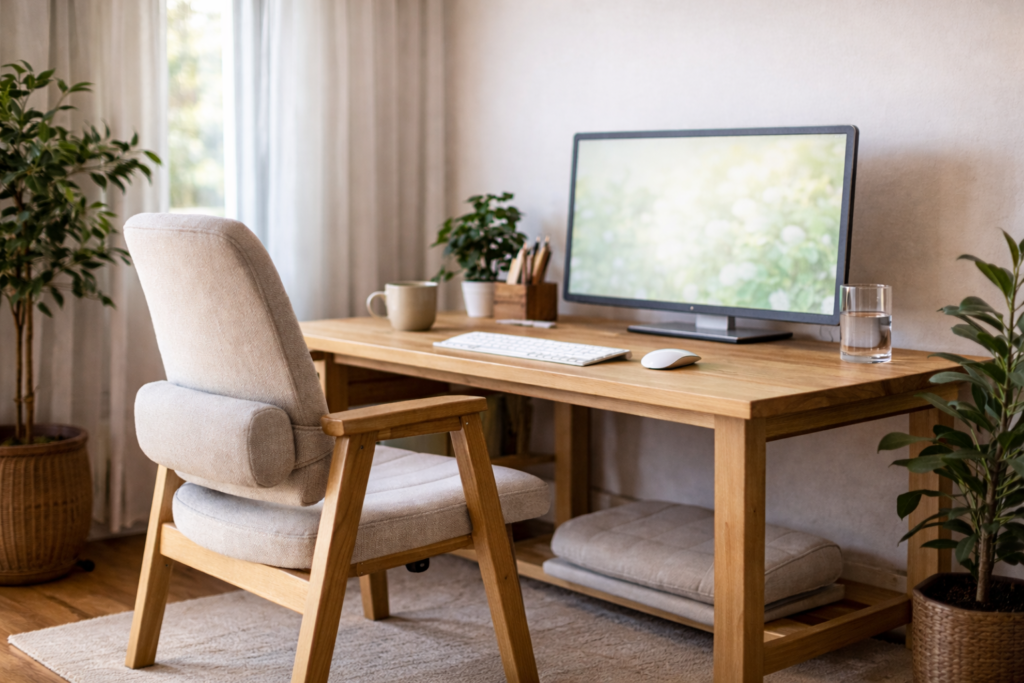
1. The Chair That Changed Everything
The first product that made a noticeable difference was my chair.
I didn’t buy the most expensive one. I bought one that:
- Supported my lower back
- Allowed small movements
- Let my shoulders relax
Within a week, my lower back stopped tightening by mid-afternoon. That alone convinced me ergonomics was real.
2. Desk and Screen Adjustments I Didn’t Know I Needed
I raised my screen so I wasn’t constantly looking down.
That single change reduced my neck stiffness more than any stretch ever did.
I also adjusted my desk height so my elbows sat naturally at about 90 degrees. Typing stopped feeling oddly tiring.
3. Small Accessories That Had Outsized Impact
A footrest surprised me.
Standing mats in the kitchen surprised me even more.
I hadn’t realized how much fatigue came from standing still on hard floors while cooking. Once I added a cushioned mat, my legs didn’t feel as heavy afterward.
Ergonomics Beyond Work: Where It Really Added Up
The biggest lesson was this: ergonomics doesn’t stop when work ends.
I noticed changes when I:
- Supported my neck properly while reading in bed
- Used a reclined position instead of slouching forward on the couch
- Paid attention to how I lifted groceries and laundry
These moments used to feel insignificant. They weren’t.
A Simple Framework That Kept Me Consistent
I stopped trying to “fix everything” and followed this:
1. Notice
Where do I feel tension?
2. Adjust habits
Can I move, reposition, or pause?
3. Add support
Does a tool make this easier?
4. Reassess
What feels better after a week?
This kept ergonomics practical, not overwhelming.
Signs I Ignored for Too Long (That You Don’t Have To)
Looking back, the signs were obvious:
- Feeling more tired at home than outside
- Stiffness that lingered into the evening
- Discomfort that disappeared when I changed environments
Those were not “just age” or “normal fatigue.” They were signals.
What Ergonomics Gave Me
Not perfection.
Not zero discomfort.
It gave me:
- More energy at the end of the day
- Less background pain
- A home that actually supports recovery
And most importantly, it taught me that comfort is not something you earn after exhaustion.
Bottom Line
Ergonomics is not about expensive setups or rigid rules.
It is about:
- Awareness
- Small, repeatable habits
- Thoughtful support
Start with one thing. One adjustment. One habit.
That is exactly how I started, and it was enough to change everything.
About the Author
Hi, I’m Beulahna. I spent years feeling quietly drained at home before realizing how much daily discomfort I had normalized. Through simple ergonomic habits and gradual changes, I learned how powerful alignment and support can be. I share practical, lived-in guidance for creating homes that feel restorative, not exhausting. When I’m not writing, you’ll usually find me reading with a cup of tea comfortably supported, on purpose.